

Best Areas to Invest €1M in Barcelona: Liquidity, Stability & Exit Strategy
If you are evaluating the best areas to invest €1M in Barcelona, your objective as an international investor is unlikely to be short-term speculation. You are allocating capital within a structured European framework and assessing liquidity profile, regulatory exposure, and long-term risk-adjusted return. The decision is not about prestige; it is about resilience, resale depth and disciplined entry pricing.
The best areas to invest €1M in Barcelona are those that combine supply constraints, diversified demand and consistent transaction volume within prime residential segments. For non-resident investors targeting a 7–15 year horizon, capital preservation and exit clarity matter more than marginal yield differences. When structured correctly, a €1M allocation in Barcelona can provide stable positioning within a broader international portfolio.
Selecting the right district requires balancing micro-location liquidity, tenant demand stability and long-term urban planning dynamics. Prime does not automatically mean optimal; what matters is how each area performs under stress conditions and during cyclical slowdowns.
1. Defining the Best Areas to Invest €1M in Barcelona
The best areas to invest €1M in Barcelona refer to consolidated prime residential districts that demonstrate sustained transaction volume, limited oversupply risk, and predictable resale demand across domestic and international buyer segments. These areas operate within a mature EU legal framework and offer structured capital allocation stability rather than speculative upside.
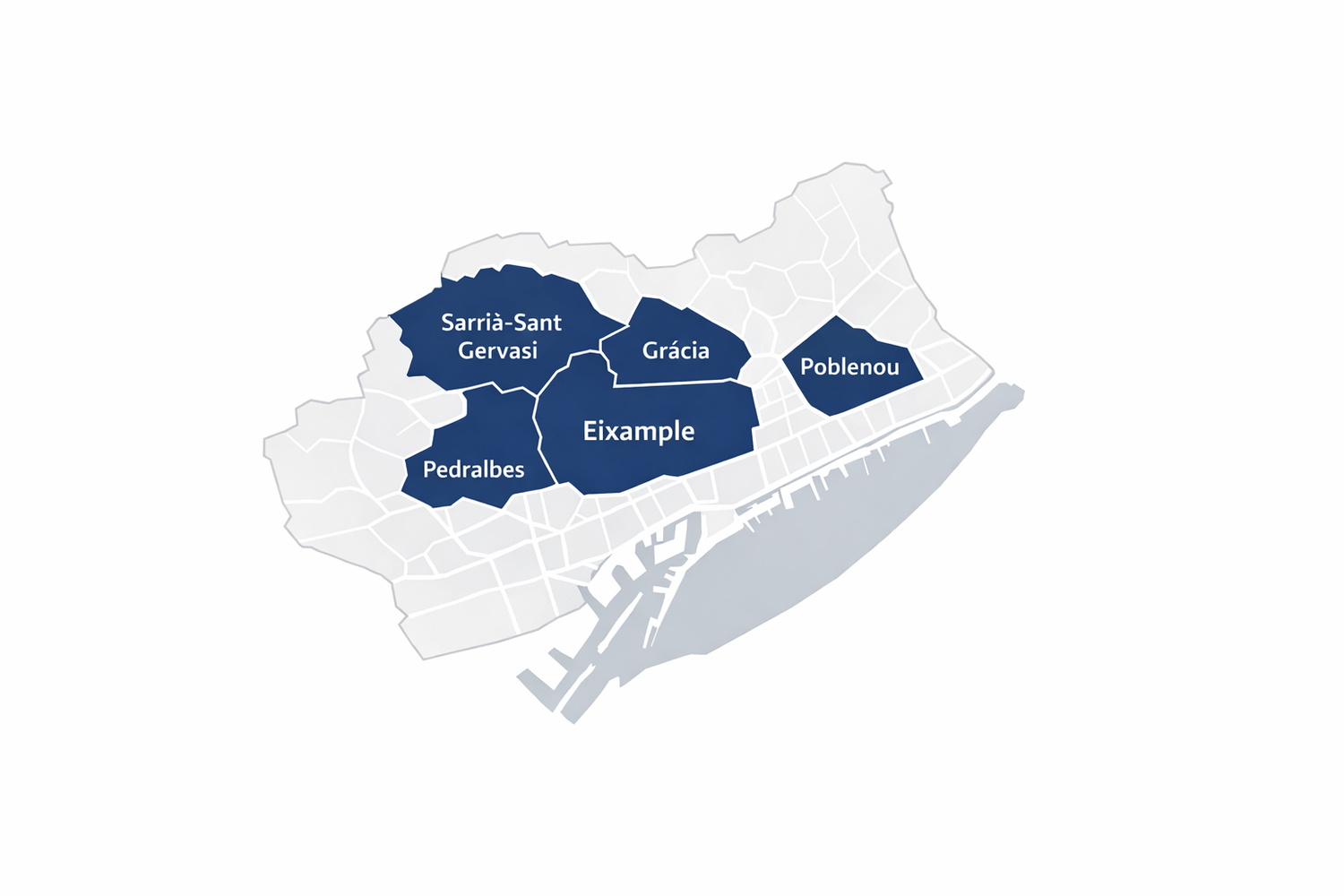
At the €1M level, your purchasing power typically allows access to:
Renovated apartments in Eixample
Family-oriented properties in Sarrià-Sant Gervasi
Larger residences in Pedralbes
Select assets in Gràcia or Poblenou prime pockets
The definition of “best” must be aligned with:
Liquidity depth
Exit strategy clarity
Controlled regulatory exposure
Micro-market supply constraints
Prime positioning does not eliminate risk; it reduces volatility relative to secondary zones.
For broader structural stability context, see Is Barcelona a Safe Investment?
2. Eixample: Liquidity and Transaction Depth
Eixample remains one of the most liquid districts in Barcelona.
From a liquidity profile perspective, Eixample benefits from:
High transaction frequency
International buyer recognition
Mixed residential-tenant base
Strong resale comparables
At €1M, you are typically targeting 100–150m² renovated units in central or left Eixample. Rental demand is diversified between professionals, relocating executives and long-term tenants.
The main advantage of Eixample is exit strategy clarity. During market slowdowns, liquidity tends to compress less severely than in niche districts.
However, entry pricing must be disciplined. Overpaying erodes long-term risk-adjusted return more than in peripheral areas due to tighter yield compression.
3. Sarrià-Sant Gervasi: Stability and Family Demand
Sarrià-Sant Gervasi operates as a stability-focused district with strong domestic demand.
At the €1M level, you access larger family-oriented properties. Tenant turnover is lower, contributing to a stable income predictability profile.
The district benefits from:
Established schools
Residential zoning stability
Lower short-term rental pressure
Reduced speculative construction
From a capital preservation perspective, Sarrià-Sant Gervasi often exhibits lower volatility than trend-driven districts.
If your strategy prioritises conservative allocation with limited regulatory sensitivity, this district aligns well with long-term holding structures.
4. Pedralbes: Prestige and Low-Density Protection
Pedralbes offers low-density planning and limited new supply.
Supply constraints here are structural due to zoning restrictions and limited development parcels. This enhances downside protection but reduces transaction frequency compared to Eixample.
Liquidity is narrower but stable among high-net-worth domestic and international buyers. Your exit audience is smaller yet financially resilient.
Rental yields in Pedralbes are typically lower than in more central districts. For yield benchmarking, review Rental Yields in Prime Barcelona.
Pedralbes is suitable if your objective emphasises asset quality and long-term wealth preservation over income optimisation.
5. Emerging Prime Pockets: Gràcia and Poblenou
Selective areas within Gràcia and Poblenou have transitioned into semi-prime status.
These districts may offer marginally higher rental yields but introduce:
Greater volatility risk
Development-driven supply shifts
Tenant demographic variability
Buying property in Barcelona as a foreign investor requires understanding that emerging zones can compress liquidity during downturns.
If your allocation prioritises moderate appreciation potential with acceptable risk tolerance, carefully selected micro-locations in these districts may align.
However, your transaction discipline must be stronger here than in established prime areas.
6. Regulatory and Legal Framework Considerations
Investment decisions in Barcelona operate within a structured EU and Spanish legal framework.
Ownership security is reinforced by the Spanish Land Registry, which provides transparent title verification. Taxation for non-residents is administered by the Spanish Tax Agency.
You must assess:
Rental cap applicability
Zoning designation
Urban planning compliance
Community liabilities
For acquisition structure, consult the Complete Guide to Buying as a Foreigner.
Long-term rental vs short-term licensing distinctions are detailed in Long-Term vs Short-Term Rental Legal Update.
Regulatory clarity reduces systemic risk but requires continuous monitoring.
7. Yield vs Liquidity: The Allocation Trade-Off
The best areas to invest €1M in Barcelona are not necessarily those with the highest rental yield.
A core investor question is whether to prioritise yield or liquidity.
Higher yields often correlate with:
Peripheral positioning
Narrower resale audience
Greater sensitivity to economic slowdown
Lower yields in central prime zones may reflect stronger liquidity resilience and deeper buyer pools.
A 3.5% yield in Eixample with high transaction depth may produce superior long-term risk-adjusted return compared to a 5% yield in less liquid districts.
This is a classic capital allocation trade-off between income and exit stability.
8. Structured Area Selection Framework
Before allocating €1M, apply this five-step Area Selection Framework:
Step 1 – Liquidity Assessment
Analyse transaction volume and historical resale timelines.
Step 2 – Supply Constraint Review
Evaluate development pipelines and zoning rigidity.
Step 3 – Regulatory Exposure Mapping
Confirm rental regulations and urban planning limitations.
Step 4 – Tenant Demand Stability
Assess demographic consistency and rental absorption.
Step 5 – Exit Strategy Clarity
Define likely resale buyer profile and holding horizon.
The best areas to invest €1M in Barcelona are those that score consistently across all five dimensions, not those that excel in only one.
9. Final Assessment: Liquidity, Stability and Exit Strategy
The best areas to invest €1M in Barcelona are consolidated prime districts such as Eixample, Sarrià-Sant Gervasi and Pedralbes, each offering distinct advantages in liquidity depth, stability and supply constraints.
Eixample provides transaction volume and international resale recognition. Sarrià-Sant Gervasi offers family-driven stability and moderate volatility. Pedralbes delivers low-density protection and wealth-preservation characteristics.
For international investors allocating €800K–€1.5M, optimal district selection depends on aligning liquidity profile, regulatory exposure tolerance and long-term capital allocation strategy.
The best areas to invest €1M in Barcelona are those where disciplined entry pricing, structural supply constraints and diversified demand combine to support predictable exit pathways and balanced long-term risk-adjusted returns within a stable European framework.
If you require structured evaluation of a specific district or asset, the Investment Advisory page outlines the independent advisory framework.

HELLO
I'M CARLOS CARSTENS

Independent Property & Investment Advisor in Barcelona.
I represent capital and property decisions with structure, discipline and long-term clarity.


